It is the year 2009. I am at Boyd Hill preparing to interview Ginger, one of the volunteers. She works at the front desk of the education center and greets people as they enter the park. She is perfect for the job because she is friendly and loves to talk to people. I decide to interview her while she works the front desk. I ask her if she has any memorable stories to tell; her face lights up and she begins to tell a story about an alligator and some tourists. It goes something like this.
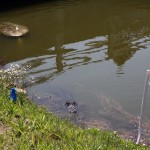
Alligator, MLK Bridge (Robin Shwedo)
Ginger appeared to assuage the tourists fear that the alligator was dead and hung up the phone. A few minutes later, however, the tourists call Ginger again and exclaim that they feel positive the alligator is dead. They tell Ginger that the alligator’s eyes are closed and it is not breathing, but Ginger once again tells them that the alligator is simply soaking up the sun’s energy and will remain motionless; once again the tourists appear to be mollified by Gingers persuasive explanation. Ginger continued to go about her business when she receives a third phone call from the same tourists who whisper that they are about two feet from what they feel absolutely positive is a dead alligator! Ginger yells STOP through the phone and tells the tourists to slowly step away from the alligator and don’t do anything until a ranger comes out to check on the alligator. When the ranger drives up to the tourists, the alligator, which is very much alive, springs to life and slides into the water. The tourists are astonished and later admit to Ginger that she was right. They came to Boyd Hill looking for a mythical Florida alligator, but little did they know that would have a close encounter of the alligator kind. One day, a group of tourists visit Boyd Hill, and they tell Ginger that they want to see a real alligator. Ginger tells them that an alligator has been spotted near Wax Myrtle Pond. The tourists thank Ginger and quickly make their way into the park. About twenty minutes later, Ginger receives a call from the tourists who tell her that the alligator is dead. Ginger, knowing that people often times mistake a dead alligator for a live alligator, assured the tourists that the alligator is alive and is sunning itself. Alligators are exothermic, which means that their body temperature fluctuates depending on the temperature of the air. If the ambient air temperature is cool, alligators may indeed look dead to the untrained eye because they remain motionless until it is warm enough to move.
Alligators are common at Boyd Hill. I saw an alligator on almost every visit to Boyd Hill when I was filming. One reptilian resident of Boyd Hill, however, had eluded me: the mystical alligator known as Half Jaw, aptly named because it was missing half of its upper jaw. After months of searching, I had my own close encounter of the alligator kind. My story goes something like this.
One day I was at Boyd Hill crouched on my stomach filming gopher tortoises when I heard the puttering engine of a golf cart behind me. I look up, and I see Jessica (another volunteer) and Ginger in the golf cart. They tell me that Half Jaw has been spotted near the lake. They ask if I want to film Half Jaw, and I quickly hop into the golf cart. Finally, a chance to film Half Jaw! My heart is pumping as we race – albeit not to fast, we were in a golf cart – to see the alligator. What would we find? Images of a huge alligator with a fish dangling from its mangled jaw popped into my head.
When we did find Half Jaw, however, reality was not nearly as exciting. Half Jaw turned out to be only medium size, maybe about five feet. Half Jaw was not mean and scary; in fact, he seemed to be a lot more scared of us than we were of him. No one really knows how Half Jaw lost half of its upper jaw; some believe it was the result of a fight with another alligator, possibly over a female. We point and stare at Half Jaw for a few more minutes until I have enough footage. We haul ourselves into the golf cart and putter away to leave him in peace. I never saw Half Jaw again, but years later someone tells me that he was found dead by one of the rangers not that long ago. I wonder if Half Jaw realized he is an important part of the folklore of Salt Creek?
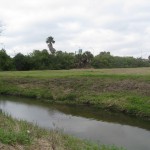
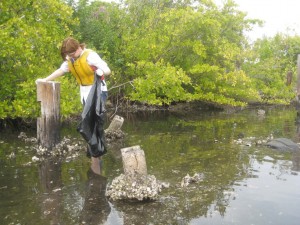
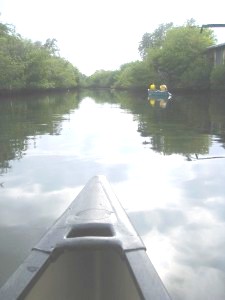 Undisturbed by the murmur of voices and the activity of half a dozen canoes paddling purposefully to clean up Salt Creek, a Brown-Crowned Night-Heron observed from branches of Brazilian Pepper and White Mangrove. When not expected, nature often delights. Prepared for the inner city, being suddenly surrounded by nature’s beauty and unexpected sunshine was a surprise. Not one of the popular city parks or nature trails, but an overlooked, neglected waterway in downtown St. Petersburg offered this glimpse of unsuspected nature. This can’t be a pastoral scene according to Greg Garrard. Where is the retreat to the country? Where the contrast between pristine nature and evil urban sprawl? Where is the hidden reality of nature’s relentless toughness? We are able to discover a peaceful, quiet scene of simple beauty within the city with harsh realities of floating garbage in the creek and trash entwined in the Mangroves.
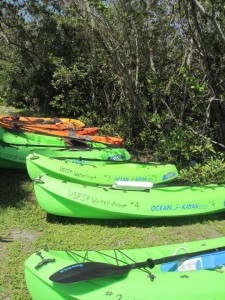 “. . . I mean that they [students] should notplay life, or study it merely, but earnestly live it from beginning to end.” (Heny David Thoreau,Walden)
 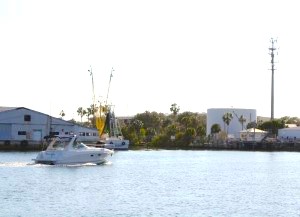 Most of us have a definite preference when it comes to water: either we feel the need to live in close proximity to a large body of water or the desire to remain completely land-locked. Even then, there’s usually some wiggle-room: a preference for living miles from the ocean doesn’t mean one can’t enjoy swimming in a lake on a hot summer’s afternoon.
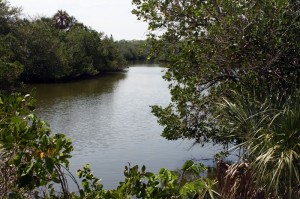 The silence back in the mangroves allows my mind and imagination to wonder. Back here on this pond, surrounded by foliage its easy to imagine being somewhere else, some-when else. The canoe gently coats along the placid water. Here is a retreat that is sheltered from the world, hidden away from all the busy rush of everyday life. A peer over the side of canoe. The water is shallow and a ghostly underwater world lays just inches beneath the surface. Twisting branches rise up in the water and light filters down around them, forming otherworldly shadows. Everything is a single uniform gray-black color, almost the color of ash. Here and there a single bright red leaf breaks up the monochromatic underwater world.